
 admin
admin We Are Spiritual Souls
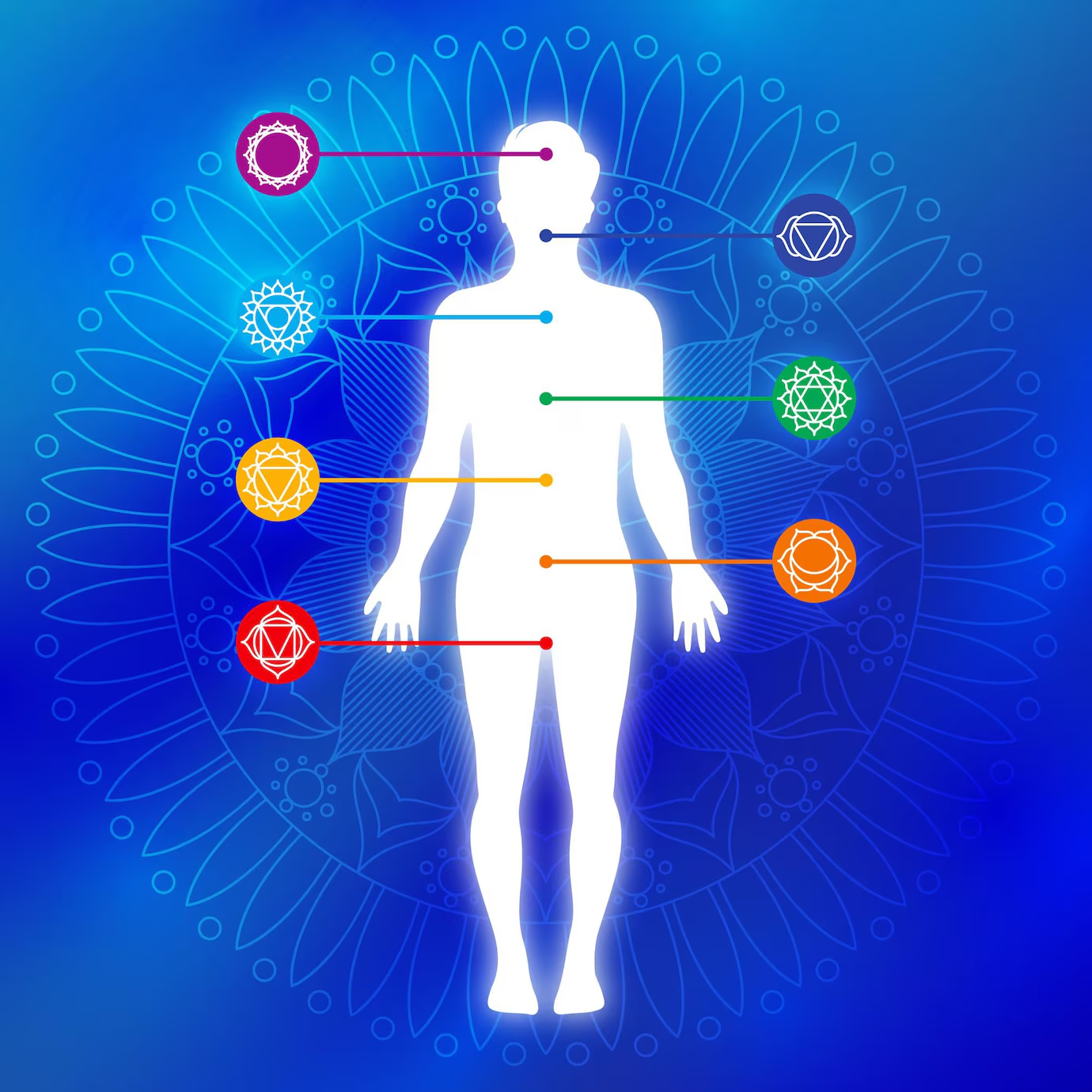
Each of us is an eternal, individual spiritual soul, emanating from Krishna, the Supreme Divine Being. Though both Krishna and we are spiritual in nature, we are never equal to Him. Krishna is like the powerful sun, and we are like tiny rays of sunlight—similar in quality, but vastly different in magnitude.
Like Krishna, we have form, and we are conscious, eternal beings full of bliss. We possess many of the wonderful qualities of God, but only in a limited way.
Our true identity lies in our eternal relationship with Krishna. Self-realization means awakening to that forgotten connection. The best use of our free will—part of our spiritual nature—is to engage in Bhakti-yoga, the path of loving devotion, and rediscover who we truly are.
Understanding Ourselves
We are not our bodies. We are the soul—the conscious life force dwelling within. Our bodies are like intricate machines, and we, the soul, sit in the heart, guiding and witnessing everything through the senses, mind, intelligence, and ego.
True spiritual knowledge begins when we understand the difference between body and soul—between matter and spirit. The body goes through many changes—childhood, youth, old age, and death—but the soul remains the same. That’s why we always feel like the same “I” despite the body constantly changing.
Matter is temporary. Spirit is eternal. And so, we, as eternal souls, are far more significant than the perishable body. Real knowledge means understanding this truth.
The Purpose of Human Life
We are by nature full of knowledge and joy. The human body is a rare opportunity to engage in spiritual practice and free ourselves from the cycle of birth and death—existence in bodies full of suffering.
As Krishna says in the Bhagavad-gita (2.16):
“Those who are seers of the truth have concluded that of the non-existent [the body] there is no endurance, and of the eternal [the soul] there is no change. This they have concluded by studying the nature of both.”
Even great scientists, like Nobel Laureate Niels Bohr, recognized that consciousness lies beyond physics and chemistry. Consciousness is not a product of matter but a symptom of the soul—an irreducible, spiritual reality.
All living beings, from plants to humans, have consciousness in varying degrees. It cannot be created in a lab; it is the presence of the soul.
When the soul leaves the body, we call it death—more accurately, a passing on. Consciousness, the sense of “I am,” is something no machine can replicate. Material science cannot detect spirit, but the spiritual science of the Vedas can guide us to understand it.
Our Original Consciousness
In our pure, original state, we are fully conscious of our relationship with Krishna. But now our awareness is absorbed in the body and material identity. Evidence such as past-life memories and near-death experiences also points to the existence of the soul beyond the body.
We don’t need these material bodies to exist. As souls, we have our own spiritual senses, mind, and identity. Our personalities are unique, eternal, and unchanging. We don’t dissolve into some impersonal force—we are always individual persons.
Sadness, ignorance, and death are unnatural to us. That’s why we resist them. We are meant for knowledge, bliss, and eternal life.
Our Natural Role is to Serve
Although God is infinite and we are small, we are meant to serve Him in love. Just as heat is inseparable from fire, our intrinsic nature—dharma—is to love and serve Krishna. Only when we reconnect with that service do we find true fulfillment.
We have free will. We can choose to serve Krishna or to turn away and try to enjoy separately from Him. But separation leads to repeated birth and death in the material world. Spiritual practice gives us the chance to awaken love for Krishna and return to our real home.
Spiritual and Material Bodies
In both the material and spiritual worlds, the soul has a form. In the spiritual world, that form is eternal, full of knowledge and bliss. There, the soul’s senses and desires are pure and completely connected to Krishna. These bodies are not limited by matter and can accomplish anything through will alone.
In the material world, we accept different kinds of bodies based on our desires and actions. According to the Vedas:
- There are 8,400,000 species of bodies, each reflecting different material desires.
- Though we live in the body, Krishna remains the real owner and controller of it.
- The body is made of unattractive materials—blood, bone, skin, etc.—yet illusion makes us see it as beautiful.
- Every body undergoes six changes: birth, growth, sustenance, reproduction, decline, and death.
- The body is just a machine, through which the soul seeks—but never truly finds—happiness.
The Gift of Human Life
Among all forms of life, the human form is most valuable because it provides the intelligence required for spiritual realization. Lower life forms lack this capacity. Human life comes with responsibility—we must rise above animalistic pursuits (eating, sleeping, mating, defending) and strive for self-realization.
With so many other forms of life, human birth is exceedingly rare. Let us not waste it. By taking up Bhakti-yoga—the path of devotion—we can attain life’s ultimate goal.
Love and Free Will
Krishna created us to love Him, but love must be voluntary. That’s why He gives us the freedom to choose. When we misuse that freedom and turn our love toward temporary things, we suffer.
True love for Krishna fulfills us. But misdirected love—toward the material—leaves a deep void. Now, in human life, we have the chance to make things right. Through Bhakti, we can reawaken that love and return to Krishna’s loving embrace.
Why There’s Suffering
The material world is like a virtual reality. We suffer because we identify with the body instead of the soul. Krishna designed this world with suffering to remind us that real happiness lies only in Him.
The Vedas describe three main categories of suffering:
- Miseries from the Body and Mind – pain, disease, aging, mental distress…
- Miseries from Other Beings – conflict, betrayal, violence, wild animals…
- Miseries from Nature – extreme weather, natural disasters…
All suffering arises from forgetfulness of Krishna. By returning to Him, we reclaim our eternal, blissful nature.
Awakening Divine Love
Love for Krishna eternally resides in every soul. It is reawakened by hearing and chanting about Him. When that love matures into pure devotion, the soul returns to Krishna’s world, never to return to this realm of suffering.
Spiritual life is centered on love—Bhakti. Pure love attracts Krishna, especially when it is so deep it transcends even reverence.
Each soul shares a unique, eternal relationship with Krishna, expressed in one of five moods:
- With awe and reverence
- As a servant
- As a friend
- As a parent
- As a lover
As Sri Chaitanya Mahaprabhu taught:
“It is the living entity’s constitutional position to be an eternal servant of Krishna, because he is the marginal energy of Krishna and a manifestation simultaneously one and different from the Lord—like a molecular particle of sunshine or fire.”
(Chaitanya Charitamrita, Madhya 20.108)
Let us remember who we are—eternal souls meant to love Krishna—and begin our journey home.
Would you like this adapted into a booklet, a poem, or a script for a video or presentation?